About the Blend Network
Understand how the Blend Network hides the link between a block proposer and their proposal.
The Blend Network adds a layer of anonymity for block proposers on top of Cryptarchia, the Logos Private Proof of Stake consensus protocol. Cryptarchia uses a private leadership election as a first line of defence against deanonymisation, but preventing adversaries from learning about proposers through network monitoring needs stronger obfuscation. The Blend Protocol provides it: an anonymous broadcasting protocol that makes it hard to link a message to its sender through network analysis. The Blend Network is the service made up of nodes that opt in to run the Blend Protocol, and those nodes are rewarded for participating.
The basics
- The Blend Network adds anonymity for block proposers on top of Cryptarchia's Private Proof of Stake consensus.
- Messages are wrapped in multiple layers of encryption and routed through random paths of nodes, each adding a random delay before forwarding.
- Nodes must explicitly opt in through the Service Declaration Protocol and prove ownership of a note with a minimum stake to enjoy full privacy benefits.
- Mantle transactions can also be sent through the Blend Network via a Proof of Work mechanism.
Objectives
The main objective of the Logos Blend Network is to reduce the probability of linking a block proposal with its proposer, which also translates to increasing the difficulty of learning the proposer’s relative stake. At the same time, the Blend Protocol was designed to minimise bandwidth usage on the network compared to general-use mixnets, and to maximise decentralisation by involving all nodes in the obfuscation process. By doing so, the Blend Network increases the cost of attacking the network to deanonymise a block proposal without straining the network with high bandwidth usage.
The Blend Network supports the privacy of the Logos Blockchain as a whole, by providing additional anonymity to block proposers, protecting against adversaries with both a complete (global) and partial (local) view of the Logos Blockchain. The anonymity provided by the Blend Network also substantially improves the privacy guarantees of Cryptarchia by making it even harder to learn a proposer’s relative stake - which would allow an attacker to estimate the likelihood of that node winning the leadership election.
How the Blend Protocol works
The Blend Network makes it difficult to link a block proposer to their proposal by having the message travel between several nodes before being revealed. Blend nodes (also known as core nodes) must maintain a minimum number of connections with other nodes, and cannot exceed a maximum frequency of messages they can send - putting an upper bound on bandwidth usage.
While dedicated participation in the Blend Network is reserved for declared Blend nodes, proposals and other messages can also be sent to it from regular Logos nodes. The following steps illustrate the process which a message goes through before being broadcast and included in the chain.
-
The message sender selects a random path of nodes along which it will relay its message to the receiver, covering the message in layers of encryption for every node on the path.
-
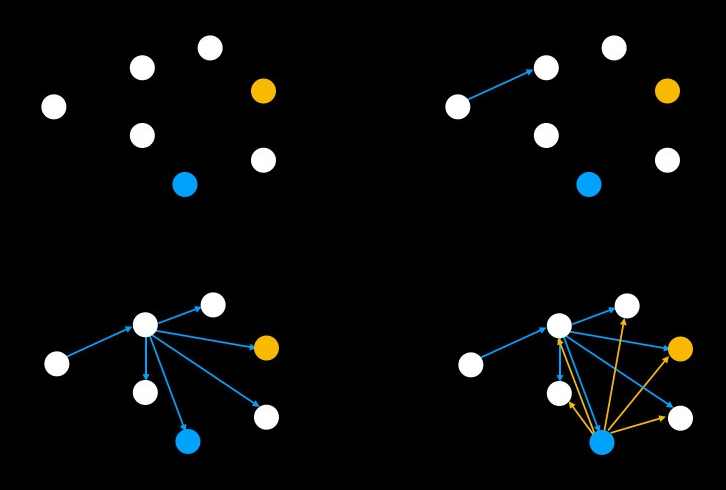
The sender sends the layered message to every Blend node with which it maintains a peer-to-peer connection. This process, known as dissemination, is shown below.
-
When a Blend node receives a message, it checks that the message is unique and has not yet been seen, relaying it to its own peers. This ensures that every message is ultimately disseminated to the entire network.
-
A Blend node that receives a message will also attempt to decrypt the message. If it is able to decrypt the outer layer of a message it receives, it relays this decrypted message (after a randomised delay) to its peers for the next node in the path to receive and decrypt.
-
When the receiver finally receives its message, it decrypts this message and is able to retrieve the original payload. This payload is then broadcast to the Logos Blockchain as a block proposal.
This process of hiding messages under several layers of encryption and randomly delaying their propagation at each stage of dissemination is known as message blending. When a message is disseminated to all nodes, observers cannot determine which node was the intended receiver, even if they can identify the sender. Due to the layered encryption, observers also cannot determine which "hop" of the relay process the message is currently on. This decryption at each node in the path transforms messages, so the incoming and outgoing messages cannot be linked together based on their content.
Random delays are the other component of message blending. If messages are rare (as in a low bandwidth network like the Blend Network), then an observer may be able to link even encrypted messages if they are disseminated in close succession. To prevent this, every message is assigned a random delay by the node processing it, with each message being released in the order it is received once its delay period has passed. This ensures that incoming and outgoing messages cannot be linked together based on their timing.
Cover traffic
An important way that the Blend Network obscures network patterns is by producing indistinguishable messages within a "crowded" network. To increase this effect in an environment where proposals are relatively rare, the Blend Network also produces artificial cover messages. Cover messages do not contain any meaningful payload and are generated by Blend nodes to increase network noise and to blend in with data messages that carry real payloads.
Cover messages mimic the behaviour of data messages, in that they are disseminated and processed by Blend nodes in the same manner. Blend nodes repeatedly encrypt random payload data to generate a cover message, which is then relayed to the next node in its selected path via dissemination. At each step in the transmission process, intended nodes decrypt, randomly delay, and disseminate cover messages without any indication that they may not be genuine. In fact, encrypted data and cover messages are completely indistinguishable even to adversary-controlled Blend nodes (a type of local observer). The hiding effect provided by cover traffic is illustrated in the diagram below.
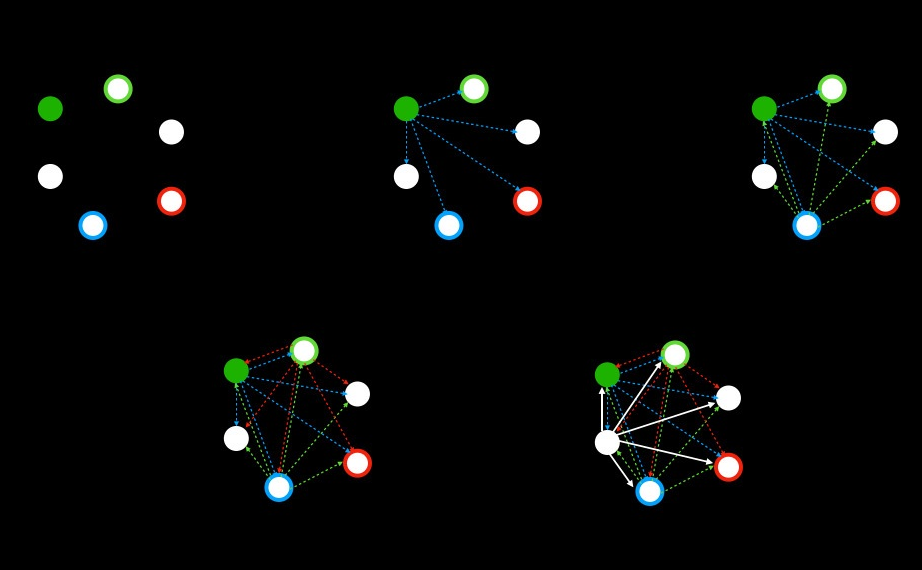
Disseminated Blend Network cover traffic (dotted lines) obscuring a data message (solid lines).
To avoid the network getting congested with too much message traffic, the Blend Network places a quota limiting the number of cover messages produced by each node, as well as the number of nodes in the path of each cover and data message. Adherence to this quota is verified via a zero knowledge proof.
Participating in the Blend Network
Participation in the Blend Network as a Blend node is more complex than running a Logos Blockchain node. The protocol relies on an agreed-upon sets of active participants to ensure its correct operation, as Blend nodes must keep track of connections to other Blend nodes for message relaying. As a result, it is not possible to allow dynamic participation in the Blend Network as it exists for Bedrock. Participation in the Blend Network is therefore not incumbent upon a node unless it opts in.
Node roles: core, edge, and broadcast
A Logos Blockchain node operates in one of three modes in terms of its engagement with the Blend Network. These roles are refreshed every epoch based on the set of active Blend declarations for that epoch:
- Core node—a node that has opted in through the Service Declaration Protocol and locked the required stake. Core nodes carry out the message blending: they relay and blend messages for others, resulting in maximum privacy for their own proposals. Core nodes receive rewards for their efforts via the SRDP.
- Edge node—a node sending a message through Blend (such as a block proposal or Mantle transaction) that has not declared as a core node but participates whenever there are enough core nodes in that epoch. An edge node sends its own messages through the core nodes for blending, gaining limited privacy without relaying for others.
- Broadcast—a fallback method used when fewer than the minimum number of core nodes are active in an epoch. With too few core nodes to blend through, a sender will broadcast its message directly, without Blend privacy for that epoch.
Only the core role requires operator action—an SDP declaration, a locked stake, and a publicly reachable Blend port (see Join the Blend Network as a core node). By contrast, a Logos Blockchain node participates as an edge node if the chain is online and enough core nodes exist, and falls back to broadcast mode otherwise. The minimum number of core nodes needed for edge participation is set by the network.
Sending Mantle transactions via Proof of Work
In addition to block proposals, nodes can also send Mantle transactions directly through the Blend Network. Using a Proof of Work mechanism known as EmPoWering, even a user without any notes benefits from some of the privacy provided by the Blend Network. However, as an edge node, their transaction will not have the full privacy that core nodes enjoy.
To send a Mantle transaction through the Blend Network, a user chooses a value and hashes it together with the consensus randomness value for the current or previous epoch. This hash is compared to a threshold value derived from the transactions in the epoch before last - if the hash is below the threshold, the user is eligible to send a Mantle transaction via the Blend Network. This transaction gets added to the mempool of the last node on its Blend path, eventually being included in a block in a way that makes it infeasible to link the transaction with the user that sent it.
While Logos note transfers and most channel inscriptions are not private, EmPoWering can be used to inscribe arbitrary data on-chain in a private way. To do this, the user should first mine some notes and submit the claim transaction via PoW through the Blend Network. Then, they can submit an inscription transaction to a new Mantle channel through Blend, which will add the desired data to the chain. To avoid linking this inscription with future ones, the user should then throw away the channel's signing key.
Service Declaration Protocol
Logos nodes that choose to participate in the Blend Network explicitly declare their intent by using the Service Declaration Protocol (SDP). The goal of the SDP is to create a single repository of identifiers to determine which nodes have opted into the Blend Network at a given time.
The SDP provides a standardised mechanism for Logos nodes to declare their participation, demonstrate activity, and withdraw when desired. It operates around a schedule measured by consensus epochs. This protocol creates a single repository of identifiers used to establish secure communication between nodes and manage service participation.
The SDP consists of three basic steps, each of which represents a type of message sent by a participating node to Mantle:
- Declare: A node elects to participate in a given service.
- Active: To continue participating, the node must regularly send an "active" message. Nodes that have not sent an active message for a prolonged period of time have their declarations withdrawn.
- Withdraw: A node withdraws its declaration and stops providing a service.
To submit a service declaration, a node must prove that it owns a note with a service-dependent minimum stake value. This note is locked for the duration of the declaration, but remains eligible for consensus leadership. The stake requirement makes service declarations sufficiently expensive to avoid spamming or Sybil attacks. Nodes participating in services are assigned addresses (known as locators) based on the Multiaddr scheme, allowing them to communicate securely while engaging in a service.
Service Reward Distribution Protocol
The Service Reward Distribution Protocol (SRDP) enables deterministic, efficient, and verifiable reward distribution to nodes based on their participation in Bedrock Services. Like the SDP, it also operates around epochs. The SRDP process unfolds over three key phases, distributing rewards based on node activity from previous epochs. These phases are:
- Activity tracking: Nodes participating in services submit active messages to attest to their participation in the previous epoch.
- Reward calculation: At the end of the epoch, the system calculates rewards for nodes that participated in the previous epoch.
- Reward distribution: Starting immediately after the epoch when activity messages are submitted, rewards are gradually distributed to active service nodes. Each block includes one Mantle transaction that can distribute rewards to up to four nodes.
The selection of nodes receiving rewards in each block follows a deterministic, pseudo-random process based on the Cryptarchia epoch randomness from the start of the epoch. This approach ensures fairness and prevents manipulation of the distribution order.